Tuesday, October 13, 2020

How to Cope with Mask-Associated Dry Eye (MADE)

With the COVID-19 pandemic among us, expert and government recommendations have prompted mandates for face mask use in addition to social distancing. The use of face masks helps thwart coronavirus transmission. As the world emerges from shutdowns and the season changes from summer to winter, the imposed use of face masks for extended periods will increase.

To combat the spread of COVID-19, these preventative measures are essential. However, a new phenomenon is emerging: increasing reports of dry, uncomfortable eyes. Is there a science behind this trend, who is at risk, and what are the solutions?

Mask-Associated Dry Eye (MADE) was first described in June by an ophthalmologist who noticed an increase of these patients. A study published in July examined the issue further. Existing dry eye disease patients report worsening symptoms. Previously asymptomatic people are now complaining of dry, uncomfortable eyes, accompanied by inconsistent vision. These symptoms seem to occur most when reading or using digital devices for an extended amount of time.

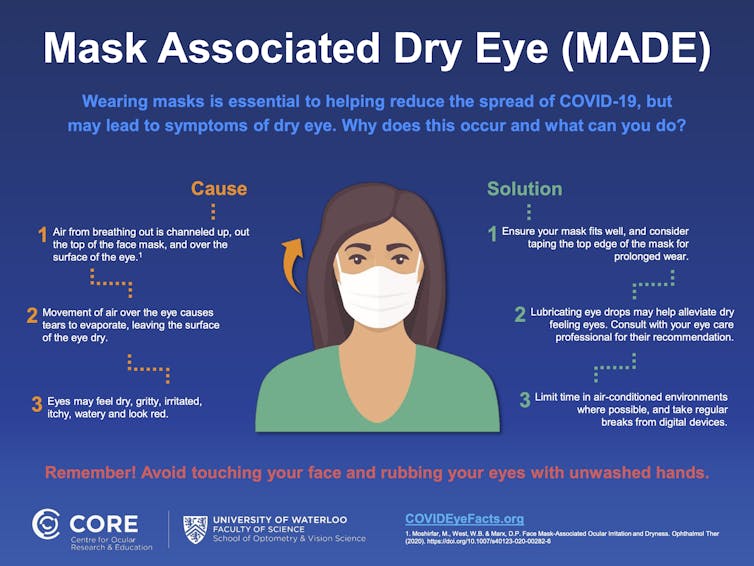
Face masks drastically reduce the outward spread of air from the mouth and nose; however, exhaled breath still needs to diffuse. Masks that fit loosely against the nose cause the airflow to extend upward, forcing a stream of air over the surface of the eye. Those who wear glasses are familiar with this effect, as lens-fogging often occurs when a mask is worn. This repeated cycle can lead to dry eyes when masks are worn for extended periods. People who insert contact lenses daily are especially susceptible to dry eye since the ocular surface is already compromised by the lens.

There are a few ways to alleviate MADE. First, ensure your face mask fits appropriately, especially when wearing glasses. For prolonged use, consider applying athletes’ tape along the top edge and nose area. Consult with your eye care professional and utilize lubricating eye drops. When possible, limit time in air-conditioned, windy, or especially dry environments. Lastly, take regular breaks from digital devices.


To read further, check out the original article or read this manual for tips on how to wear a face mask if you suffer from dry eyes. For a more permanent MADE solution, contact the Rohr Eye & Laser Center to schedule an appointment for laser vision correction today.

Rohr Eye & Laser Center offers the most advanced technology available to provide personalized and extraordinary care to our patients. Whether your goal is to maintain or improve your natural vision, we are here to help you. Call us at 877-579-0202 or visit https://www.michiganlasik.com/ to schedule an appointment today.

Written by the digital marketing staff at Creative Programs & Systems: www.cpsmi.com.

Wednesday, September 23, 2020

Healthy Cardiovascular Health Also Promotes Good Eye Health

 In a new study published by the American Journal of Medicine, investigators found that a healthy lifestyle – typically associated with cardiovascular health benefits – also lowered ocular diseases, particularly diabetic retinopathy. The conclusions suggest that attempts to prevent cardiovascular diseases might potentially counteract ocular ones as well.

Nearly 2.2 billion people worldwide suffer from ocular diseases. The consequences of these diseases are vision impairment and blindness. About half of these cases are preventable; the leading causes of eye issues include age-related macular degeneration, diabetic retinopathy, cataract, and glaucoma.

"Earlier studies have observed associations between eye diseases and individual lifestyle factors such as smoking, obesity, or hypertension," said lead investigator Duke Appiah, Ph.D., MPH, Department of Public Health, Texas Tech University Health Sciences Center, Lubbock, TX, USA. "It is known that these metrics of ideal cardiovascular health do not work alone and may interact additively to result in diseases. However, prior to our research, no other studies have comprehensively evaluated the association of all of the metrics of ideal cardiovascular health with ocular diseases."

The findings show that practicing a healthy lifestyle and implementing beneficial habits are both factors in achieving cardiovascular strength. Age-related macular degeneration, diabetic retinopathy, cataract, and glaucoma can all be minimized by having an active, healthy lifestyle. Those with optimal cardiovascular health had 97 percent lower odds for diabetic retinopathy than individuals who did not.

"Overall, we believe that primary prevention and early detection approaches of ocular diseases are important, considering that over half of all deaths from ocular diseases and cardiovascular diseases are known to be preventable," commented co-investigators Noah De La Cruz, MPH, and Obadeh Shabaneh, MPH, both from the Department of Public Health, Texas Tech University Health Sciences Center, Lubbock, TX, USA.

At Rohr Eye & Laser Center, we strive to provide excellent customer service. We specialize in assisting patients with ocular diseases such as glaucoma, macular degeneration, and cataract by means of laser vision correction. Contact us today for more information.


Rohr Eye & Laser Center offers the most advanced technology to provide personalized and extraordinary care to our patients. Whether your goal is to maintain or improve your natural vision, we are here to help you. Call us at 877-579-0202 or visit https://www.michiganlasik.com/ to schedule an appointment today.

Written by the digital marketing staff at Creative Programs & Systems: www.cpsmi.com.
Thursday, September 10, 2020

Laser Treatment Success in Glaucoma Patients Discovered by Researchers


Glaucoma is a condition that causes buildup from fluid and pressure inside the eye. If untreated, it can eventually lead to blindness. Over 70 million people worldwide are diagnosed with glaucoma. Therapies to help remediate pressure include eye drops (which help reduce fluid produced by the eye) or surgery to unblock the eye’s drainage system.

Thanks to a study conducted by the University of Missouri School of Medicine and MU Health Care, a non-invasive treatment called Selective Laser Trabeculoplasty (SLT) might provide glaucoma relief. This process uses a laser to modify eye tissue and release fluid, which allows drainage to occur.

The MSM and MUHC research teams reviewed 252 SLT procedures on 198 patients diagnosed with open-angle glaucoma. Following surgery, 33.6 percent of patients achieved a 20 percent or higher reduction in intraocular pressure (IOP) after two months. At six months, 38.5 percent of patients had diminished IOP. Overall, patients with a higher baseline IOP had considerable reductions in pressure.

"There's been a lack of evidence about how well SLT works, how safe it is and the ideal candidate," said senior author Jella An, MD, an assistant professor of ophthalmology and a fellowship-trained glaucoma specialist at MU Health Care's Mason Eye Institute. "Because so little is known about SLT, there is a lot of apprehension among specialists about using it as a first-line treatment for glaucoma. Our research findings have helped me redefine the ideal patient for this procedure."

Rohr Eye & Laser Center specializes in eye laser treatment therapy. Our goal is to get you the best vision possible. For more information regarding laser treatment success in glaucoma patients, read this article by Science Daily.


Rohr Eye & Laser Center offers the most advanced technology to provide personalized and extraordinary care to our patients. Whether your goal is to maintain or improve your natural vision, we are here to help you. Call us at 877-579-0202 or visit www.michiganlasik.com to schedule an appointment today.

Written by the digital marketing staff at Creative Programs & Systems: www.cpsmi.com.

Tuesday, August 25, 2020

Saints QB Jameis Winston Opts for LASIK Eye Surgery

 NFL Saints Quarterback Jameis Winston is the latest pro athlete to undergo LASIK eye surgery. The QB said he could read license plates and street signs following the surgery. He said, “I think precision in the vision is the biggest difference.” Previously nearsighted in addition to having astigmatism, which is a curvature in the eye or lens, Winston’s vision is now corrected.

 A growing number of professional athletes are choosing to undergo LASIK eye surgery. Some famous athletes include Tiger Woods, Tiki Barber, Dwayne Wade, Carson Wentz, Lindsey Vonn, Kirk Cousins, LeBron James, Wilson Ramos, Greg Maddux, Patrick Ewing, and Chris Paul.


Vision is integral to an athlete’s performance. Without strong vision, performance on the athletic field is diminished. Quarterback football players are continually shifting their eyes by calculating depth, distance, and rapidly-moving players. The quick decisions he makes based on his vision capabilities are what could win or cost the game.


Glasses or goggles can impair and even be potentially hazardous to athletes due to their susceptibility to damage and inability to protect their eyes during rain or snowstorms. LASIK eye surgery is a perfect option for athletes and other individuals who move quickly or are frequently in the elements.


Read the full article for more information about Winston’s LASIK experience.


Rohr Eye & Laser Center offers the most advanced technology available to provide personalized and extraordinary care to our patients. Whether your goal is to maintain or improve your natural vision, we are here to help you. Call us at 877-579-0202 or visit https://www.michiganlasik.com/ to schedule an appointment today.

Wednesday, August 12, 2020

PRK vs. LASIK Eye Surgery: What’s the Difference?


PRK (photorefractive keratectomy) is a type of refractive surgery to correct myopia (nearsightedness), hyperopia (farsightedness), and astigmatism. It was the first surgery developed for vision correction and came before the popular LASIK procedure. PRK works by reshaping the cornea using an excimer laser. It’s similar to LASIK in that they both use lasers during treatment; however, PRK surgery takes slightly longer to recover from. PRK’s are still commonly performed and, in some cases, offer advantages over LASIK eye surgery 


Both LASIK and PRK work by reshaping the cornea using an excimer laser, allowing light to enter the eye to focus on the retina for clear vision. The main difference between PRK and LASIK is the first step of the procedure. During PRK, the thin layer of the cornea (epithelium) is removed before reshaping the underlying corneal tissue with an excimer laser. The epithelium regenerates itself (grows back over the cornea) within a few days after surgery. With LASIK, a thin flap is created on the cornea using a microkeratome or a femtosecond laser. The flap is lifted to expose the underlying corneal tissue and is replaced after the cornea is reshaped with an excimer laser. 


LASEK (with an e) is essentially another version of PRK; however, this procedure entails removing the outer layer of the epithelial layer of the cornea. As with PRK, LASEK involves lifting the epithelial layer by using a trephine, a type of surgical instrument. The epithelial layer is preserved during surgery and then placed back on the eye’s surface once the procedure is complete. LASEK has decreased in popularity due to the slower recovery of vision compared with PRK. The epithelial layer that is placed back on the eye takes longer to recover in LASEK than the growth of a new layer as in PRK. 


After Surgery: 


Outcomes of PRK and LASIK are very similar. Many people can achieve 20/20 vision once they have had the procedure, and almost all patients achieve a 20/40 visual acuity or better. After PRK and LASIK surgery, complications are rare but can occur. Complications can include infection and starbursts or halos around lights at night. Reading glasses may also still be required after PRK surgery once you reach your 40s, due to an age-related loss of near vision called presbyopia. 


When it comes to corrective vision, LASIK is by far the most popular option for the majority. However, it’s essential to follow the guidance and judgment of your eye surgeon regarding whether PRK or LASIK is the best option for your individual needs. 

Wednesday, May 13, 2020

Thin Cornea Treatment Options

The human eye is an amazing organ comprised of fifteen parts, all working together so we can experience vision. Over time, our eyes start to age showing signs of lost efficiency of various functionalities. One of the main parts of the eye, the cornea, is a fascinating piece of tissue. It is comprised of five layers, all of which are designed to be optically transparent. 

The cornea provides a surface for the tear film, the layer of moisture with multiple functions, to cling to. Light is bent by the greatest degree when passing through these structures so it can be focused on point with the retina. The crystalline lens accounts for the remaining third of refractive power. 

Refractive issues appear when the power of these anatomical components – the cornea and crystalline lens is not well coordinated with the physical length of the eyeball. In hyperopia (long-sightedness), the eyeball is too short for its refractive power, and in myopia (short-sightedness), it is too long. 

Common surgeries such as LASIK and PRK have addressed this imbalance of refractive power to eyeball length by reshaping the cornea. Thin corneas can be treated with refractive procedures, and treatment suitability is also subject to other eligibility criteria such as pre-existing corneal disease and even lifestyle factors. Therefore, it is important to choose the appropriate candidates for each type of procedure.

The minimum corneal thickness required for refractive surgery is dependent on the degree of refractive error that needs to be corrected. The higher the refractive error, the higher the prescription required, and usually, the more tissue that needs to be removed. 

LASIK procedures require the creation of a flap of corneal tissue and, for those with thin corneas, make it challenging for reshaping. PRK surgery solves this issue by removing the very top layer, known as the epithelium, which leaves the rest of the corneal matter available for sculpting by laser. However, there are still requirements for patients considering PRK surgery, and sometimes other options must be considered that do not involve a laser to reshape the cornea. 

Some options include intraocular contact lenses, or implantable contact lenses (ICL). These lenses are artificial and are made of biosynthetic material that goes between the iris and the crystalline lens. However, not everyone may benefit from these lenses, and LASIK or PRK treatments may be more suitable to those who could benefit from a more permanent solution. 

Read the full article here

Tuesday, April 14, 2020

Bionic Eyes, Lenses, & Mechanical Eye Implants – The Future Technology in Eyesight


There are nearly 40 million people who have blindness and another 124 million who have low vision problems. With so many afflicted with vision issues, it’s no wonder why innovators have been long pursuing ways to restore or even augment natural eyesight into a higher-performing, more efficient, or even super-human vision. This would only be accomplished with the development of a so-call bionic eye or bionic eye implants. 

The goal of bionic eye scientists is to develop technology that’s as effective for people with little to poor vision as cochlear implants have become for those who have hearing difficulties. However, bionic eye technology is still in its infancy when compared to audio implant technology for hearing disabilities. 


Bionic Eyes are Different than Prosthetic Eyes
A bionic eye is not the same as a prosthetic eye. Prosthetic eyes sometimes called “glass eyes,” replace the physical structure and appearance of an eye that has been removed because of an accident, disease, or traumatic event.

Bionic eyes are mechanical and computational devices meant to give vision to the brain acting as a surrogate eye. Bionic eye implants, however, work on the existing eye structure to help augment vision in the damaged or impaired eye. Bionic implants are designed to achieve vision functionality over aesthetics and cosmetic reasons.

Currently, retinal implants are the only approved available bionic eyes. However, cornea transplants and cataract surgery can replace the cornea and lens if these structures are clouded or are incapable of focusing light for other reasons. 


Limitations of Bionic Eyes
Although specific bionic eye systems enable people to discern light, movement, and shapes, this technology is still limited and cannot restore sight 100%. This is mainly because the current implant has only 60 electrodes, to mimic the sight of a human eye, you would need about a million electrodes. 


The Future of Bionic Eyes
Researchers are trying to add more functionalities by increasing the number of electrodes to produce a higher quality of eyesight within bionic devices. Future implants will most likely feature a more functional vision for people who are blind. It also may be possible that bionic eyes can produce some degree of color vision. The key to higher quality vision within bionic eyes is a device that bypasses the retina and stimulates the brain directly. Read more about bionic eyesight here.